


It usually starts the same way.
You open Google Analytics at the beginning of the month, expecting routine numbers, and instead you notice something unsettling. Organic traffic is down. Not a crash, but enough to raise questions. Ten percent. Fifteen percent. Sometimes more.
Then you look deeper.
Leads are steady.
Sales haven’t dropped.
In a few cases, conversions are actually higher than last month.
That’s when the confusion sets in.
If fewer people are visiting the site, why isn’t the business suffering?
Did Google change something again?
Is SEO still worth investing in?
This is the moment many business owners and marketing directors quietly panic.
Here’s the reality.
SEO is not dead.
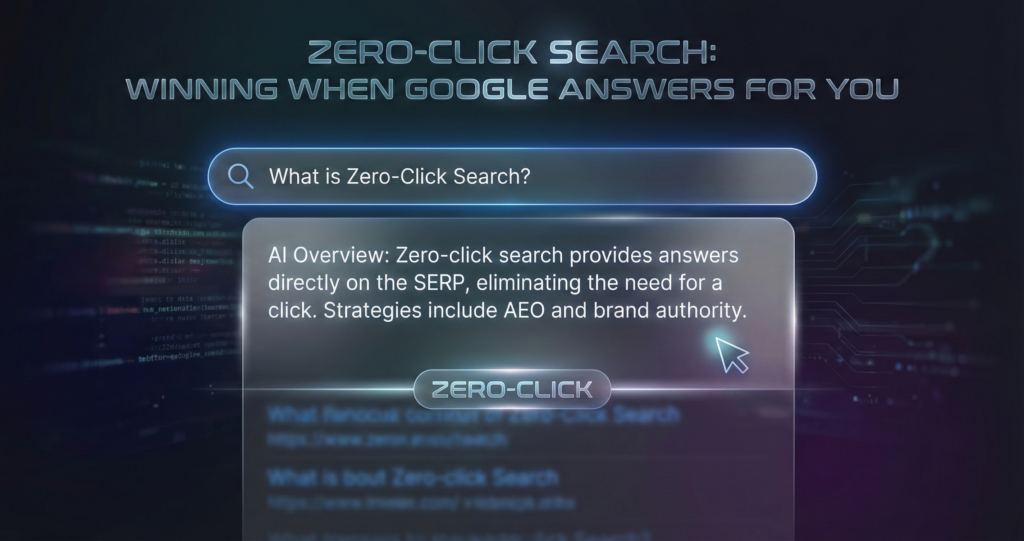
What has changed is how people interact with search results. Today, users often get what they need directly on Google through AI Overviews without clicking through to a website. This behavior is known as zero-click search.
And while it feels threatening at first, zero-click search is not a loss of opportunity. When approached correctly, it’s a signal that search is filtering out low-intent users and pushing higher-quality demand forward.
At FlipGrowth, we see this shift not as a traffic problem, but as a strategy upgrade.
Why Zero-Click Search Is Becoming the Default
Zero-click search didn’t appear overnight.
It began years ago with basic queries such as:
- weather forecasts
- exchange rates
- quick definitions
- sports scores
Google learned something important early on. Users value speed more than exploration.
What’s different today is the complexity of what Google can answer.
With AI Overviews, Google can now handle commercial and B2B queries like:
- best VPS hosting for WordPress
- is SEO worth it for businesses
- how much should I spend on digital marketing
These are decision-stage questions, not casual searches.
From the user’s point of view, this behavior makes perfect sense:
- people want immediate clarity
- they trust Google’s summarized answer
- clicking feels unnecessary unless deeper validation is needed
This is why industry data suggests over 60 percent of searches now end without a click.
Google isn’t removing value.
It’s removing friction.
The brands that struggle are the ones still optimizing only for clicks.
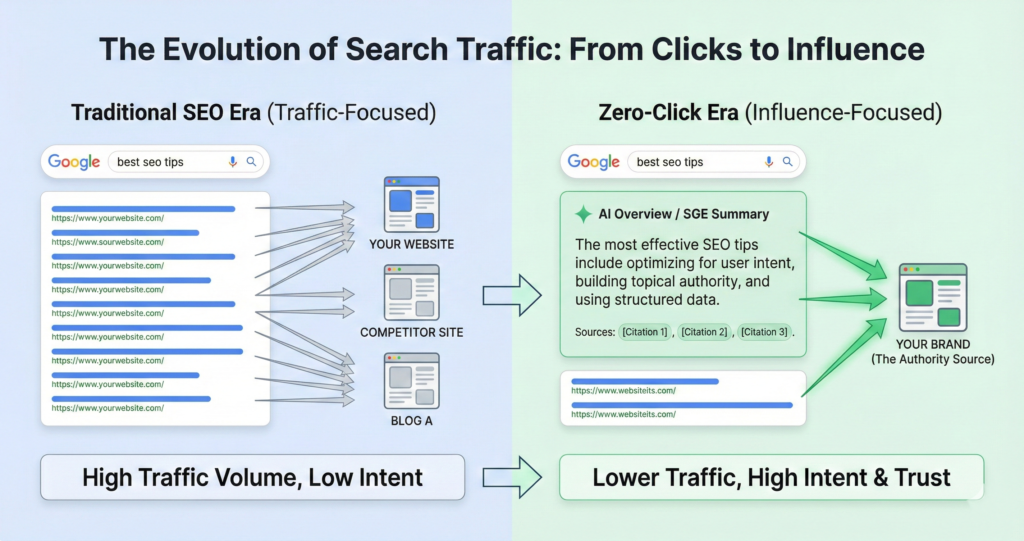
The Shift That Matters: From Traffic to Influence
For years, SEO success was measured by:
- sessions
- pageviews
- keyword rankings
The problem is that traffic alone has never guaranteed revenue.
A large portion of organic visitors fall into these categories:
- researchers
- students
- competitors
- low-intent browsers
They inflate metrics but rarely convert.
What matters now is influence at the moment of intent.
Here’s how we explain it to clients at FlipGrowth.
Think about a billboard on a busy highway.
You don’t click it.
You don’t track it.
But when you need that service later, the brand feels familiar and trustworthy.
AI Overviews function the same way.
When your brand is referenced by Google’s AI:
- authority is established
- trust is transferred
- memory is created
AI citations are digital billboards, and they work long before a click happens.
How Zero-Click Search Improves ROI
The most common concern we hear is straightforward.
Visibility sounds good, but how does it translate into revenue?
The answer lies in how AI exposure changes user behavior.
Citation Lift Builds Trust Before the Click
When your website is cited inside an AI Overview, users perceive it differently.
It’s no longer just another result.
It feels endorsed.
Studies and platform-level observations consistently show that users are around 35 percent more likely to click a link when it’s cited as a source by AI.
Even when the click happens later, trust is already in place.
High-Intent Traffic Converts Better
Traditional organic traffic often converts at:
- 1 to 2 percent for service businesses
AI-influenced traffic behaves differently.
These users:
- already understand the problem
- have consumed the explanation
- are closer to making a decision
Across FlipGrowth campaigns, traffic influenced by AI visibility regularly converts at around 10 percent or higher.
Less traffic.
More qualified intent.
Stronger ROI.
Brand Searches Increase After AI Exposure
One effect most analytics tools struggle to capture is delayed intent.
After seeing a brand cited in AI answers, users often:
- remember the brand name
- search for it later
- visit the website directly
This shows up as:
- direct traffic
- branded search growth
- unexplained homepage visits
Google created the demand.
Analytics just didn’t connect the dots.
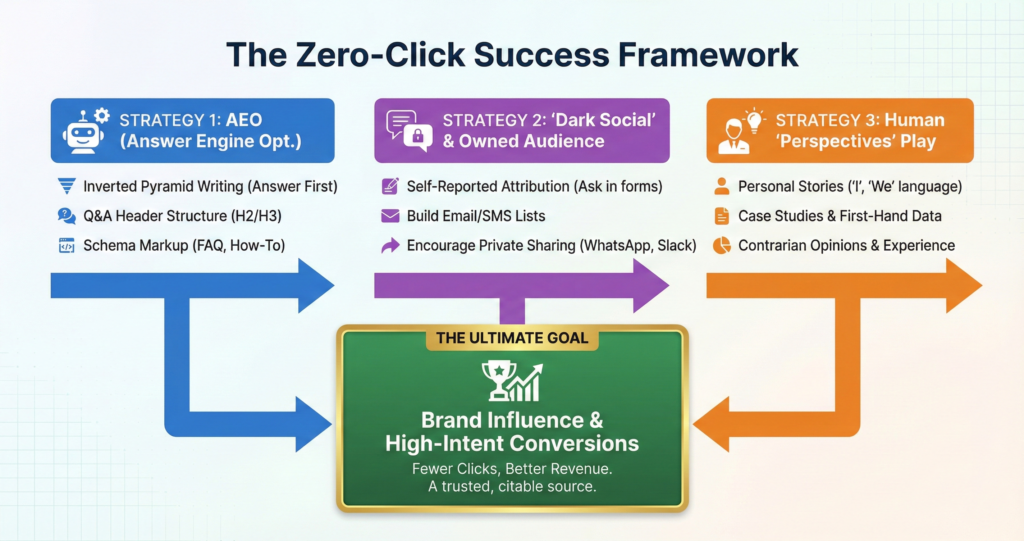
Strategy One: Answer Engine Optimization (AEO)
Search optimization now serves two audiences:
- humans
- answer engines
This is where Answer Engine Optimization becomes essential.
Lead With the Answer
AI prioritizes clarity.
Structure content so:
- the answer appears immediately
- explanation follows
- deeper context comes later
If the answer is buried, AI won’t use it.
Use Question-Based Headings
AI extracts information more accurately when headings mirror real searches.
Effective examples include:
- What is zero-click search?
- Is SEO still effective?
- How much does digital marketing cost?
This aligns content with real user intent.
Support With Schema Markup
FAQ schema helps search engines understand relationships between questions and answers.
It doesn’t guarantee AI citations, but it significantly improves clarity and extraction accuracy.
At FlipGrowth, AEO structure and schema are built into every SEO strategy we deploy.
Strategy Two: Optimizing for Dark Social
Many businesses notice rising direct traffic and feel confused.
This is often dark social at work.
What Dark Social Includes
Dark social covers:
- WhatsApp messages
- Slack conversations
- private email sharing
- screenshots of AI answers
People don’t always share links anymore.
They share names and images.
Analytics cannot reliably track this behavior.
How to Attribute It Properly
Add one simple question to your contact forms:
How did you hear about us?
You’ll start seeing answers like:
- saw you on Google
- found you through an AI result
- someone shared your name with me
Build Assets You Control
Long-term stability comes from owned audiences:
- email lists
- WhatsApp communities
- CRM-driven relationships
Search traffic is rented.
Owned audiences are assets.
Strategy Three: The Human Perspective Advantage
AI is fast and scalable, but it lacks experience.
It cannot replicate:
- lived lessons
- mistakes
- strong opinions
Google increasingly rewards content that demonstrates real-world expertise, often referred to as its “hidden gems” approach.
To stand out:
- publish case studies
- share failures and lessons learned
- take clear positions based on experience
Use first-person language.
Write like a practitioner, not a summary tool.
At FlipGrowth, human-led content consistently outperforms generic explanations.
Frequently Asked Questions
Is SEO dead because of zero-click search?
No. SEO has evolved. Today, it focuses on visibility, authority, and AI citations rather than just traffic. FlipGrowth approaches modern SEO as Answer Engine Optimization, helping brands stay discoverable and trusted even when users don’t click immediately.
How do I know if zero-click search is affecting my site?
Common signs include declining organic traffic combined with stable or improving conversions and increased branded searches. FlipGrowth analyzes impressions, lead quality, and brand demand to determine whether AI visibility is driving qualified interest.
Does zero-click search affect local SEO?
Yes. Local service queries are frequently answered directly through AI and map results. This makes brand authority critical. FlipGrowth helps local businesses structure content so they appear as trusted sources when users search for nearby services.
Should I block AI crawlers from my website?
No. Blocking AI crawlers removes your chance to be cited in AI Overviews. FlipGrowth recommends allowing AI access while optimizing content structure so your brand benefits from AI-driven exposure instead of disappearing from results.
Conclusion: Traffic Loss Is Not the Real Problem
A decline in organic traffic does not automatically signal failure.
In many cases, it means low-intent users are being filtered out.
Zero-click search rewards brands that:
- focus on clarity
- build authority
- think beyond pageviews
The brands that win won’t chase clicks.
They’ll build influence.
If you want clarity on how prepared your strategy is for this shift, an outside perspective helps.
Contact FlipGrowth for a Digital Strategy Audit and turn zero-click search into sustainable growth.