


Every digital business eventually hits the same wall. To rank and stay visible in 2025, content cannot be occasional. It must be consistent, relevant, and updated frequently. Search engines now reward freshness and depth more than ever, and that creates constant pressure on marketing teams.
The traditional approach no longer works. Hiring more writers increases costs but not speed. Manually generating content using AI tools feels efficient at first, but quickly becomes slow, repetitive, and difficult to scale. Teams spend more time managing content than growing the business.
At FlipGrowth, we stopped trying to solve this problem by adding people. Instead, we built an engine.
We designed a fully automated content system that continuously tracks industry trends, researches topics deeply, and drafts high quality WordPress articles. Human involvement is required only at the final review stage.
This is not an experiment or a concept. This is the exact production workflow we use for high volume publishers. Below, we explain how it works and why it scales.
Production Environment Specification
The system runs on a clean and stable production setup.
The core orchestrator is n8n, running in a self hosted environment on version 1.x. All automation logic, retries, and decision making are handled inside n8n.
AI reasoning and content generation are powered by OpenAI GPT-4o through the API. Perplexity is used when external verification or citation level confidence is required.
The automation stack runs on a dedicated VPS server. WordPress 6.7 is the publishing target and is connected through the REST API. Slack or Microsoft Teams approval nodes act as a safety layer to ensure no content goes live without human review.
This separation keeps the system fast, secure, and reliable.
The Architecture: Why n8n Beats Zapier in 2025
When we designed this system, Zapier was an obvious option. It is simple and connects to many tools. However, for agencies and serious publishers, Zapier introduces two major limitations.
The Cost of Scale
A proper AI content workflow includes research, validation, formatting, and checks. This easily requires fifteen to twenty steps per article. On Zapier, every step increases cost.
Publishing ten articles per day can push monthly automation costs beyond five hundred dollars.
With self hosted n8n, costs remain predictable. You pay only for server resources and API usage. Complex logic such as retries, content expansion, or quality checks can run without additional execution fees.
Agentic Workflows vs Linear Workflows
Zapier workflows follow a straight line. One trigger leads to one action and then stops.
n8n supports agent-style workflows. It allows conditions, memory, and loops.
If an AI search returns weak results, the workflow detects it, adjusts the query, and retries automatically. This level of logic turns automation into a system rather than a shortcut.
The Workflow: Step by Step Technical Guide
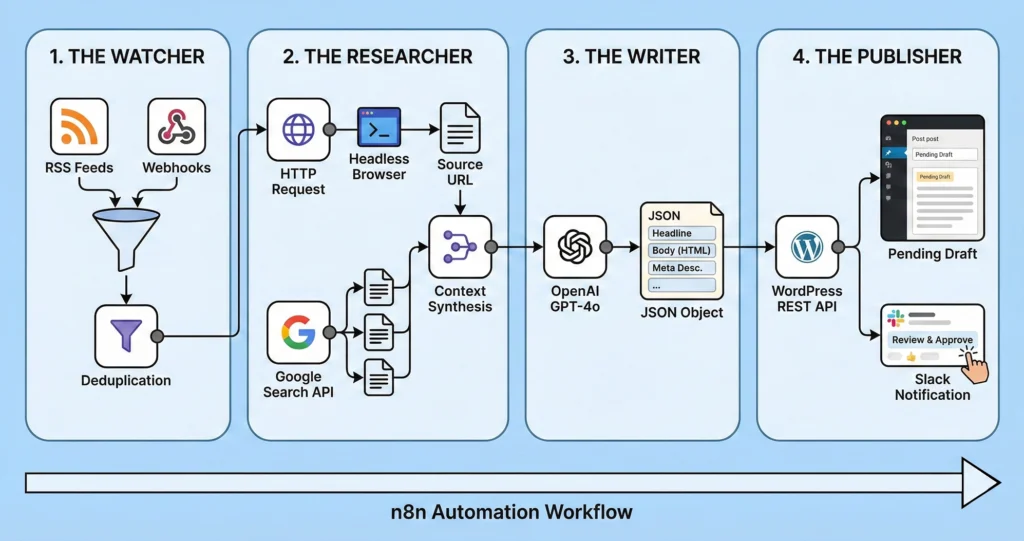
We structured the content engine into four clear phases. Each phase has one responsibility and passes structured data forward.
Phase 1: The Watcher (RSS and Webhooks)
The workflow starts with data, not prompts.
We monitor fifteen to twenty trusted industry sources using the RSS Read node in n8n. These include major publications, Google News feeds, and niche authority blogs.
To prevent duplication, a Function Item node compares incoming URLs against a stored list of processed links. If the URL already exists, the workflow stops.
Keyword filtering is then applied. If the article is generic news, it is skipped. If it matches high value topics such as AI, automation, or cloud infrastructure, it moves forward.
Phase 2: The Researcher (Headless Browsing)
Many AI automations fail because they rely on summaries instead of real research.
We use an HTTP Request node combined with a headless browser to scrape the full article content from the original source.
We then perform a secondary search using the Google Custom Search API to find three additional articles on the same topic. All four sources are provided to the AI together.
This allows the model to synthesize information instead of rewriting a single article, resulting in deeper and more trustworthy content.
Phase 3: The Writer (GPT-4o and JSON Parsing)
We do not ask the AI to write a blog directly.
Instead, we ask it to return a structured JSON object containing a headline, meta description, semantic HTML body, and a list of supporting keywords.
This structure allows n8n to map each element directly into WordPress fields. The headline becomes the post title, and the HTML body becomes the content.
This approach removes formatting errors and ensures every article is publish ready.
Phase 4: The Publisher (WordPress REST API)
WordPress is connected using application passwords, a secure method introduced in WordPress 5.6.
Articles are created with a pending status rather than being published immediately.
At the same time, a Slack notification is sent to the editorial team with the article title, word count, and a direct edit link.
This human review step is essential for trust and quality. It ensures experience and accountability before content goes live.
The Infrastructure: Self Hosting vs Cloud
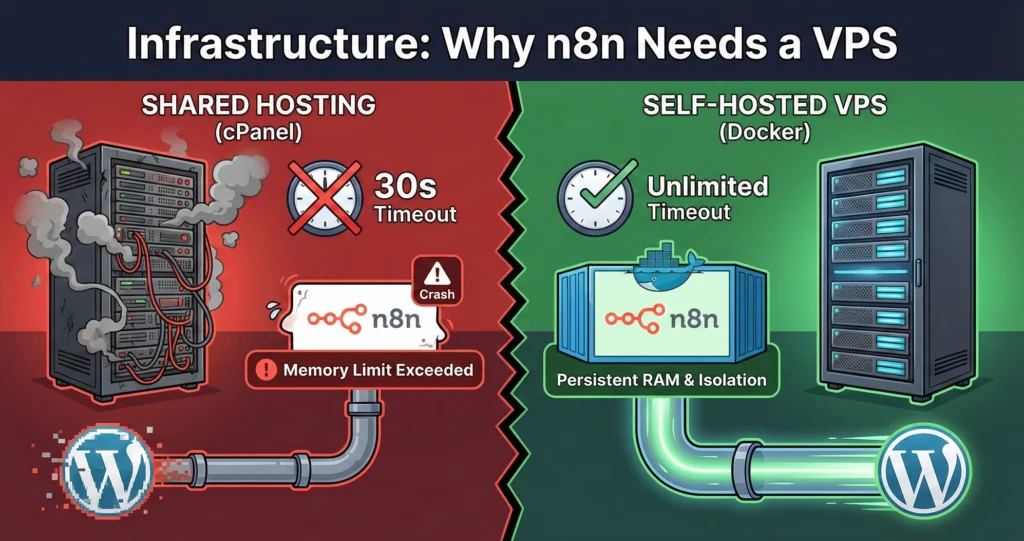
Many teams attempt to run this system on shared hosting.
That approach fails quickly. AI generation is resource heavy. A two thousand word article can take over a minute to generate. Shared hosting environments often terminate processes after thirty seconds.
We recommend running n8n on a VPS using Docker.
Persistent memory keeps workflows alive while waiting for AI responses. Isolation prevents automation tasks from slowing down your WordPress site. Full control over timeout settings ensures long running tasks complete successfully.
The Data: Productivity and ROI
We measured the performance of this system over a thirty day period across multiple content sites.
Manual agency workflows took an average of two to three hours per article. The FlipGrowth automation produced first drafts in under three minutes.
Cost per article dropped from sixty to one hundred dollars to approximately fifteen to twenty cents in API usage. Publishing frequency increased from three to four posts per week to five to ten posts per day.
More importantly, content freshness improved indexing speed. Articles started appearing in search results within one to two days instead of nearly a week. Organic impressions increased because search engines detected consistent updates.
The biggest ROI gain came from human time saved. Editors shifted from writing drafts to improving strategy, internal linking, and topical authority, which directly impacted rankings.
Productivity and Cost Comparison
| Metric | Manual Agency Process | FlipGrowth Automated Engine |
|---|---|---|
| Time to First Draft | 2 to 3 hours | Under 3 minutes |
| Cost per Article | $60 to $100 per article | $0.15 to $0.25 in API costs |
| Publishing Frequency | 3 to 4 posts per week | 5 to 10 posts per day |
| Human Effort Required | Writing and formatting | Review and strategy only |
| SEO Indexing Speed | 4 to 5 days | 1 to 2 days |
| Content Freshness Signal | Inconsistent | Continuous and predictable |
| Scalability | Limited by writers | Limited only by server resources |
What This Means for ROI
The biggest shift is not just cost reduction. It is time leverage.
Instead of spending hours creating drafts, teams now spend minutes reviewing content and hours improving internal linking, topical coverage, and distribution. Over a month, this system can replace the output of multiple writers while costing less than a single outsourced article.
For high-volume publishers, the engine pays for itself within days, not months. The long-term return comes from faster indexing, higher topical authority, and the ability to scale content without scaling headcount.
FAQ
Will Google penalize AI-generated content like this?
Google evaluates content based on quality, usefulness, and trust. It does not penalize content simply because AI was involved. When research is strong and a human reviews the final output, content performs well and remains compliant.
Is this approach safe for long term SEO?
Yes. Because the workflow focuses on original synthesis, freshness, and editorial review, it aligns with long term search quality guidelines rather than short term automation tricks.
Can n8n run on the same server as WordPress?
It is technically possible but not recommended. Running both on one server creates risk. Automation spikes can slow down or crash your website. A separate VPS ensures stability and reliability.
How are images handled in this system?
Image generation is automated using DALL-E 3 or Stability AI. The article title is converted into a structured prompt so each post receives a unique, relevant, and copyright-safe image.
Conclusion: Automation Is the New Standard
In 2025, the advantage is not writing faster. It is building systems that write consistently.
By separating drafting from editing, teams focus on strategy, creativity, and growth. Automation handles the repetitive work without sacrificing quality.
At FlipGrowth, we design and deploy these systems in production environments. Whether you need a self hosted VPS for n8n or a fully custom automation workflow, we are ready to build it.
Contact FlipGrowth today to automate your content strategy.