


When was the last time you clicked Page 2 on Google?
Now consider a more uncomfortable question. When was the last time you clicked an organic link at all?
For a growing number of users, the answer is simple. They did not. They asked ChatGPT, Perplexity, or Gemini a question, read a complete answer, and moved on. No scrolling. No comparison. No website visit. The journey ended the moment the answer appeared.
This shift is quiet, but it is fundamental. Search behavior has changed from discovery to resolution. Users are no longer looking for websites. They are looking for certainty. AI platforms now sit between curiosity and action, compressing what used to be a multi-step funnel into a single, authoritative response.
This is the zero-click reality.
Forecasts already confirm the direction. As AI assistants handle more complex and high-intent queries, the traditional “ten blue links” model is losing influence. For businesses still focused only on keyword rankings, this creates a dangerous gap between visibility and relevance.
If your growth strategy is still built around ranking pages, you are fighting a battle that quietly ended in 2024.
The new objective is not being found.
It is being cited.
The Shift From SEO to GEO
What Is Generative Engine Optimization (GEO)?
Generative Engine Optimization, or GEO, is the practice of optimizing your brand, content, and digital footprint so that AI systems include you directly inside their generated answers.
This is not an extension of SEO. It is a structural shift.
SEO vs GEO: How the Model Changed
Traditional SEO was designed for retrieval. Google acted like a librarian. You asked a question, and it showed you a shelf of books. Your job was to choose one and read it.
GEO is designed for synthesis. AI systems read the books themselves, compare information, remove contradictions, and present a single answer. The shelf disappears. Only the conclusion remains.
Traditional SEO vs Generative GEO
| Aspect | Traditional SEO | Generative GEO |
|---|---|---|
| Primary Goal | Rank higher than competitors | Be cited in the answer |
| Core Metric | Organic traffic and clicks | Brand mentions and trust |
| Strategy Focus | Keywords and backlinks | Entities and citations |
If your brand is not part of the synthesis, you do not rank lower. You simply do not exist in the response.
How AI Models Decide Who Wins
AI Thinks in Entities, Not Keywords
Large language models do not process content the way search engines did. They do not prioritize keyword frequency. They prioritize entities.
An entity is a clearly defined concept such as a company, product, service, or individual that exists consistently across the web. Strong entities have aligned data across multiple trusted sources. Weak entities rely only on self-promotion.
Repeating “best marketing agency” on a website does not build authority.
Consistent verification across the internet does.
Probabilistic Consensus and the Trust Web
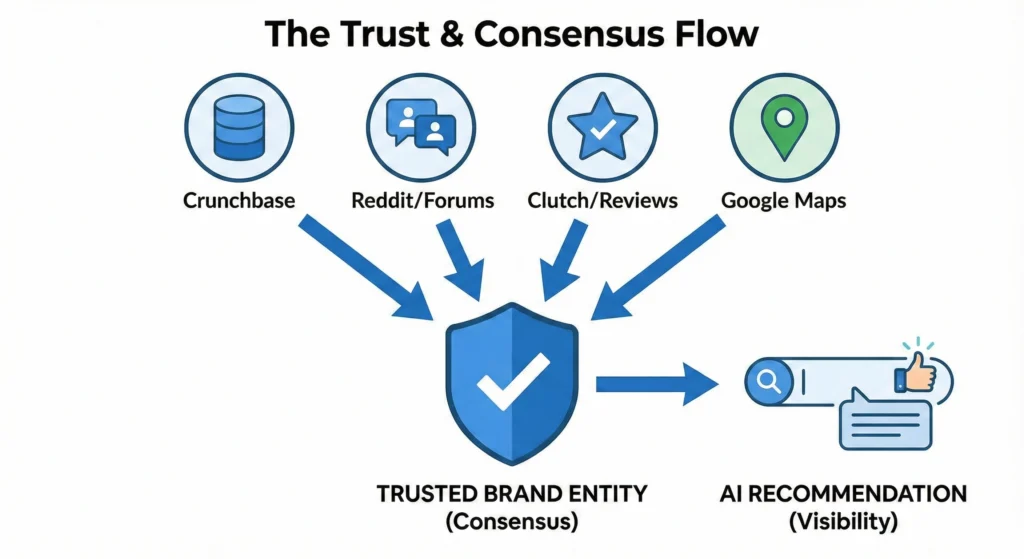
AI systems are designed to avoid hallucinations. To reduce risk, they look for probabilistic consensus.
If a brand claims authority on its website but is not supported by platforms like Crunchbase, Clutch, LinkedIn, or real user discussions, the AI treats that claim as unverified.
Consensus creates confidence.
Confidence leads to citation.
This is why GEO cannot be solved with content alone. It requires structural credibility.
The 3-Pillar GEO Strategy for 2026
Pillar 1: Technical Foundation With llms.txt
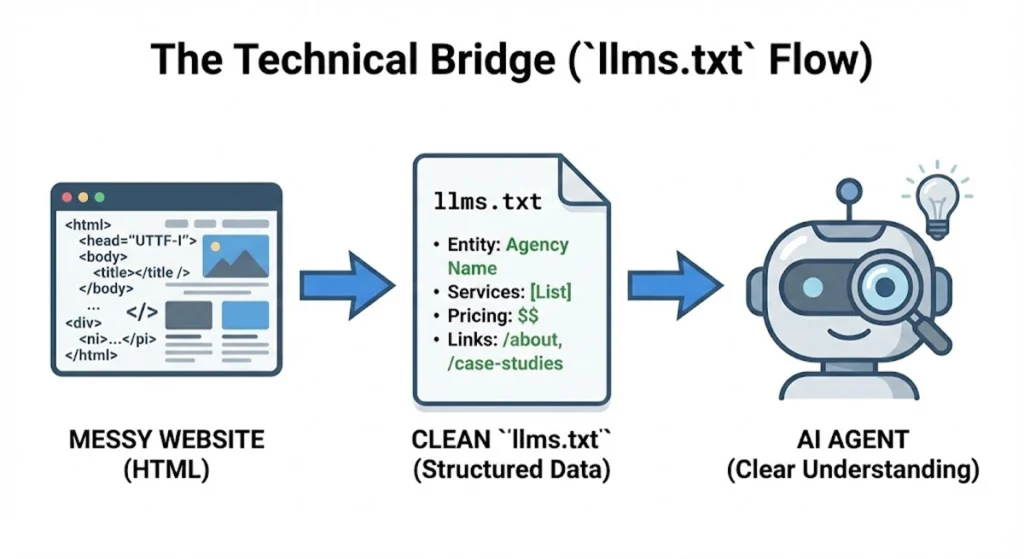
Modern websites are optimized for humans, not machines. Heavy JavaScript, pop-ups, animations, and layered UX make it difficult for AI agents to extract clean meaning.
An llms.txt file solves this.
Placed in the root directory of a website, it provides a clean, machine-readable summary explaining who the company is, what it offers, and which pages represent verified facts.
It functions as a resume for AI systems. It removes ambiguity, reduces hallucination risk, and improves citation accuracy. At FlipGrowth, llms.txt is treated as foundational infrastructure, not an experiment.
Pillar 2: Building a Citation Ecosystem
In the GEO era, backlinks matter less than citations.
A citation is a verified mention of your brand across platforms that AI systems already trust.
The AI Trust Hierarchy
Tier 1
Structured data platforms such as Crunchbase and Wikidata
Tier 2
Verified review platforms like Clutch, G2, GoodFirms, and Trustpilot
Tier 3
Human discussion platforms including Reddit, Quora, and niche forums
The strategy is straightforward. Stop buying low-quality guest posts. Start aligning, correcting, and strengthening your brand presence across these platforms. FlipGrowth treats citation consistency as a core GEO ranking signal.
Pillar 3: Information Gain Through Content
AI has eliminated the value of generic “ultimate guides.”
If an AI can generate your article instantly, publishing it adds no value. Worse, it teaches models that your brand offers nothing unique.
Information gain changes this.
Information gain is content that introduces data AI cannot invent. Examples include real experiments with budgets and outcomes, original surveys, and contrarian case studies backed by results.
When data exists nowhere else, AI systems are forced to reference the source. This is how content becomes cite-worthy instead of disposable.
Frequently Asked Questions About GEO
Is traditional SEO dead in 2026?
No, but its role is changing. Traditional SEO still supports baseline discovery and transactional queries. High-intent and complex decisions are moving to AI platforms. At FlipGrowth, SEO and GEO are treated as complementary layers.
How is GEO different from SEO in practice?
SEO optimizes pages for rankings. GEO optimizes entities for trust and clarity. FlipGrowth approaches GEO by aligning technical signals, citations, and original data so AI systems can confidently reference a brand.
Does my business really need an llms.txt file?
Yes, if authority and accuracy matter. llms.txt reduces ambiguity for AI agents and improves citation reliability. FlipGrowth includes llms.txt implementation as part of its AI visibility audits.
How do you measure GEO success without rankings?
Traditional rank tracking no longer applies. FlipGrowth measures share of model, testing brand visibility across AI platforms such as ChatGPT, Gemini, and Perplexity using structured prompts and competitive analysis.
Conclusion: The Brand-First Future of Search
The search results page is no longer the center of decision-making.
As AI collapses the distance between question and answer, the brands that win will not be the ones with perfect keyword density or endless blog output. They will be the brands with strong, verified digital entities that AI systems trust by default.
This shift is not about chasing algorithms. It is about building authority at the data level.
In a world where answers come first and clicks come later, credibility becomes the real currency.
At FlipGrowth, the focus is on building the digital infrastructure that ensures brands remain visible, trusted, and cited as search continues to evolve.
The real question for 2026 is simple.
Can the AI answer without mentioning your brand?