


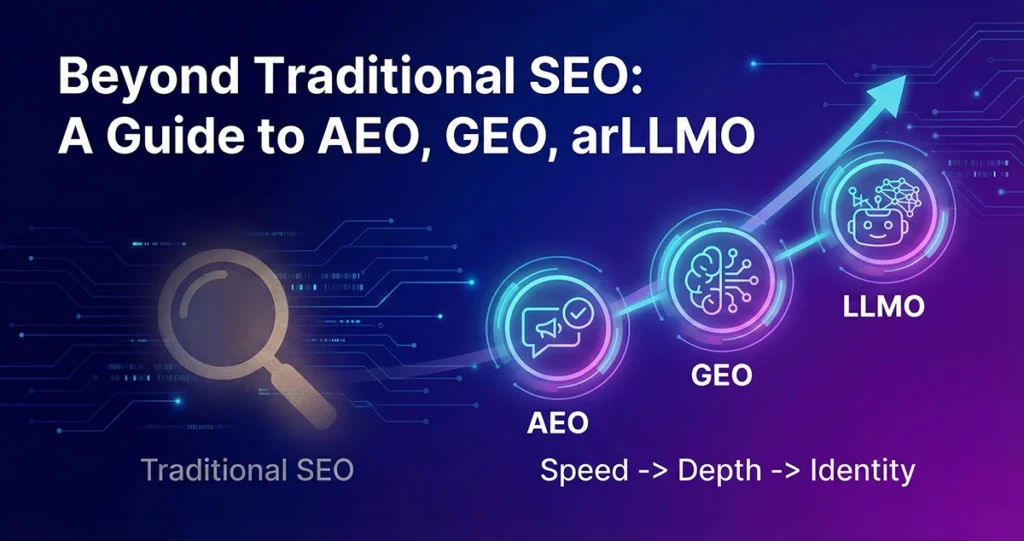
The era of ten blue links is quietly fading.
Users no longer search the way they used to. Questions are now asked to voice assistants, AI summaries appear before organic results, and chat-based tools deliver answers without requiring a single click. In many cases, users get what they need and move on, never visiting a website at all.
This shift has created a visibility problem. Traditional SEO, built on keywords and backlinks, still matters, but it no longer guarantees exposure in these new discovery environments. Ranking on page one does not mean being seen, trusted, or remembered.
This is where modern optimization begins.
AEO, GEO, and LLMO are not marketing buzzwords. They represent three distinct layers of how users now consume information and how machines decide which content and brands deserve attention.
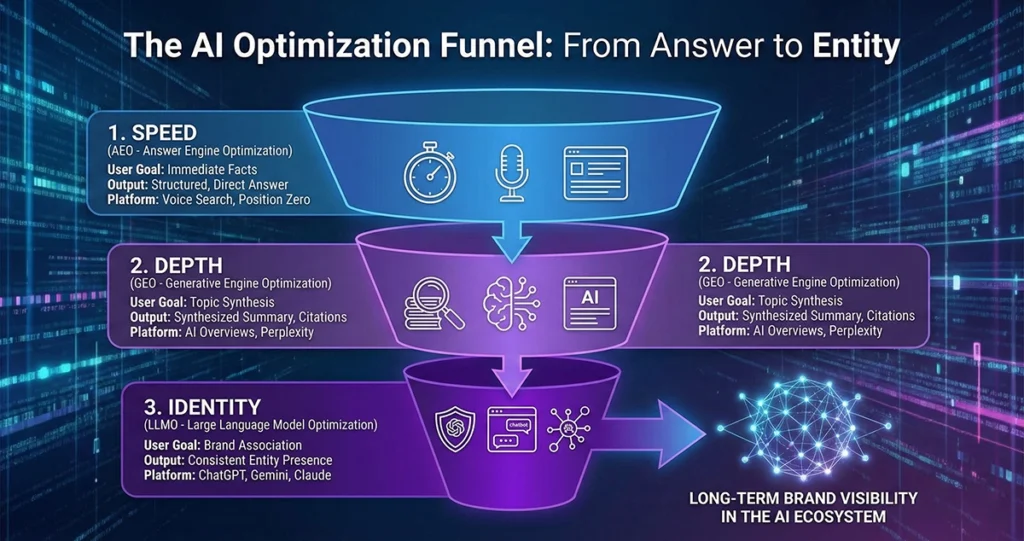
Think of them as a funnel:
- AEO handles speed
- GEO handles depth
- LLMO handles identity
Together, they define how content performs in a world driven by answers, not links.
The New Intent Funnel: Speed, Depth, and Identity
Search behavior has changed, but intent still follows a pattern.
Some users want a fast answer.
Some want a researched explanation.
Some want to know who to trust.
AEO, GEO, and LLMO align directly with these intent stages, making them easier to understand when viewed as a funnel rather than isolated strategies.
The Speed Layer: AEO (Answer Engine Optimization)
What AEO Really Means
Answer Engine Optimization focuses on delivering immediate, extractable answers.
It serves users who want facts, definitions, steps, or comparisons without reading an entire article. These users are not researching deeply. They want clarity, quickly.
AEO powers results like:
- Featured snippets
- Voice search answers
- “People Also Ask” boxes
- Instant AI-generated definitions
In this layer, speed beats storytelling.
How Answer Engines Read Content
Answer engines do not scan pages like humans. They look for structure, clarity, and proximity between questions and answers.
Well-optimized AEO content follows a simple rule:
A clear question followed immediately by a clear answer.
Practical AEO Writing Rules
- Use question-based H2 or H3 headings
- Place a direct answer in the first 40–60 words
- Use bold formatting for definitions
- Avoid long introductions before the answer
Treat the content like a dictionary entry, not a novel.
This approach increases the chance of being selected for snippets and voice results, even if overall traffic volume is lower.
The Depth Layer: GEO (Generative Engine Optimization)
What Makes GEO Different
Generative Engine Optimization is designed for AI systems that summarize, synthesize, and explain.
Unlike AEO, which extracts a single answer, GEO combines multiple sources to generate a complete response. These systems need context, authority, and supporting data to build trustworthy outputs.
GEO appears in:
- AI Overviews
- Conversational search summaries
- Research-style responses in AI tools
Why Thin Content Fails Here
Generic blog posts do not survive GEO environments.
If content simply restates what already exists online, AI systems ignore it. There is no value in citing information that can be generated instantly.
GEO rewards depth.
What Generative Engines Look For
- Original insights
- Verifiable statistics
- Expert commentary
- Structured explanations
- Logical flow between ideas
The goal is not keyword density. The goal is becoming reliable source material.
GEO Content Strategy That Works
- Expand on why, not just what
- Include data points, comparisons, and outcomes
- Explain processes step by step
- Provide context that helps AI connect ideas logically
When AI summarizes a topic, it prefers content that helps it explain confidently, not content that repeats surface-level facts.
The Identity Layer: LLMO (Large Language Model Optimization)
Why Identity Is the Final Layer
LLMO focuses on brand memory.
Large language models do not think in keywords. They think in entities. An entity is a clearly defined concept with attributes, relationships, and credibility signals.
If an AI understands who a brand is, what it does, and how it differs, it can recall and recommend that brand naturally.
This is where long-term visibility is built.
How Models Learn Who You Are
AI models rely on consistency across the web.
They look for matching signals such as:
- Brand name
- Services offered
- Founders or leadership
- Industry positioning
- Repeated mentions in trusted contexts
Inconsistent or vague descriptions weaken this understanding.
LLMO Best Practices
- Use specific language, not generic phrases
- Maintain consistent brand descriptions across platforms
- Align website content, schema markup, and citations
- Avoid conflicting messaging about services or focus
For example, stating “FlipGrowth is a digital growth and automation agency specializing in AI-led SEO strategies” is far more effective than vague descriptions like “we help businesses grow.”
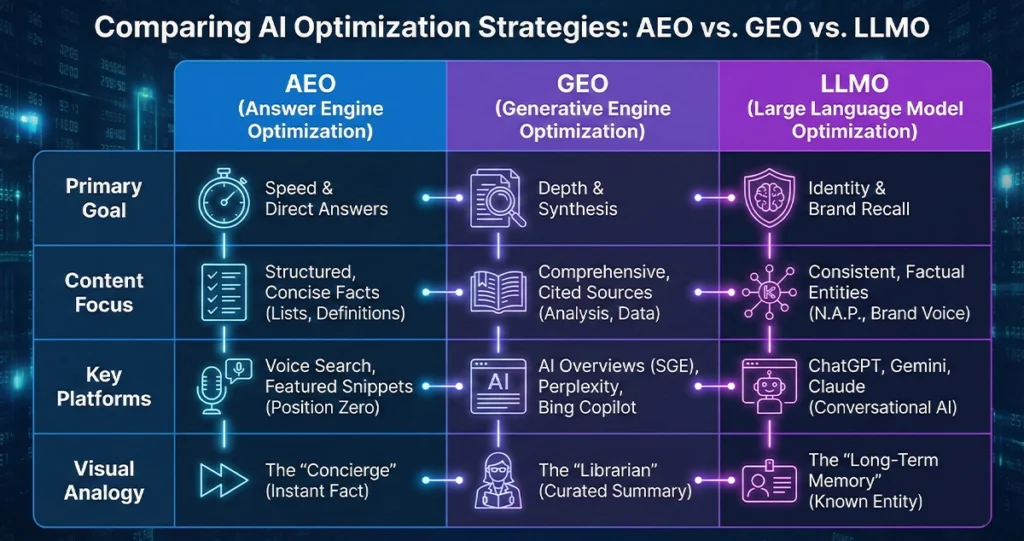
AEO vs GEO vs LLMO: How They Work Together
| Optimization Focus | Primary Goal | Where It Appears |
|---|---|---|
| AEO | Quick answers | Featured snippets, voice search |
| GEO | Authoritative summaries | AI overviews, AI research responses |
| LLMO | Brand recall | Chatbot conversations and recommendations |
Each layer supports the next. Speed attracts attention. Depth builds trust. Identity ensures recall.
The Unified Strategy: One Content System, Three Layers
There is no need for three separate strategies.
A single well-structured page can support all three layers when designed intentionally.
Top of the Page: AEO
- Clear definitions
- Concise answers
- Question-based headings
- Lists and steps
Middle of the Page: GEO
- Detailed explanations
- Supporting data
- Logical progression of ideas
- Expert insights
Backend and Metadata: LLMO
- Schema markup
- Clear entity definitions
- Consistent brand references
- Structured internal linking
This layered approach ensures content performs across search, AI summaries, and conversational platforms.
Frequently Asked Questions
Are AEO and GEO the same thing?
No. AEO focuses on extracting a single, precise answer, such as a definition or step-by-step instruction. GEO focuses on helping AI systems synthesize information from multiple sources into a cohesive explanation. At FlipGrowth, both are treated as complementary, not competing, strategies.
Do businesses really need to care about LLMO?
Yes. LLMO ensures that AI systems recognize and remember your brand accurately. FlipGrowth has observed that brands with consistent entity signals are more likely to be referenced in AI-generated recommendations, even without traditional rankings.
Will optimizing for AEO reduce website traffic?
It may reduce low-intent clicks, but it improves high-intent engagement. Users who click after seeing an AI summary are better informed and more likely to convert. FlipGrowth data shows improved conversion quality when AEO is implemented correctly.
Which strategy should be implemented first?
Start with AEO. Structuring content for quick answers is the fastest win. FlipGrowth often begins optimization projects by restructuring top-performing pages to improve clarity before expanding into GEO and LLMO layers.
Conclusion: Optimizing for Machines That Read
Search engines no longer simply point users to information. They increasingly deliver the information themselves.
This means visibility is no longer about ranking alone. It is about relevance, authority, and identity.
AEO ensures content is read aloud.
GEO ensures content is cited.
LLMO ensures the brand is remembered.
Together, they form a system designed for the future of discovery.
The businesses that win will not be those chasing keywords, but those building content ecosystems that machines trust and understand.
Want to Optimize Your Content for This New Funnel?
If your content still relies only on traditional SEO, it is time for a structured upgrade.
FlipGrowth helps brands audit, restructure, and optimize content using the Speed, Depth, and Identity framework so it performs across search engines, AI summaries, and conversational platforms.
If you want to future-proof your content strategy, contact FlipGrowth to optimize your content for AEO, GEO, and LLMO and stay visible where answers are created.