Artificial Intelligence is changing faster than most businesses expected. Just two years ago, AI tools were mostly limited to chatbot conversations and content generation. Today, the industry is moving toward autonomous AI systems that can work continuously in the background, automate workflows, and interact with real software environments without constant human input.
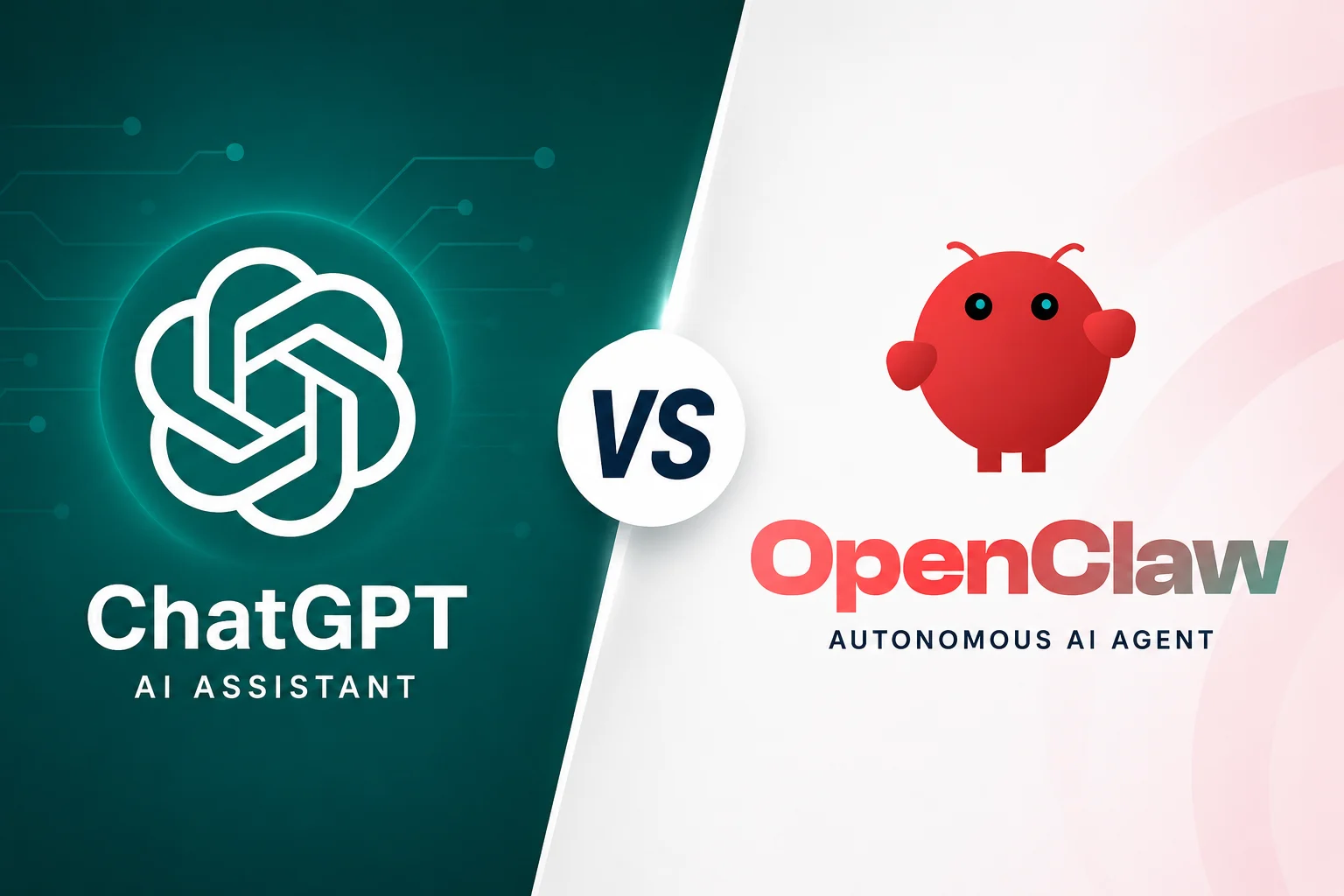
That shift created a growing comparison between ChatGPT and OpenClaw GitHub Repository. While many people assume they are direct competitors, the truth is very different. ChatGPT and OpenClaw solve completely different problems.
ChatGPT is designed as a conversational AI assistant focused on speed, simplicity, and productivity. OpenClaw is built as a self-hosted autonomous AI framework capable of running workflows, executing tasks, and staying active 24/7 in the background.
The easiest way to understand the difference is this:
ChatGPT is the intelligent assistant you ask questions to. OpenClaw is the AI operator working silently behind the scenes while you sleep.
Businesses, developers, and AI enthusiasts are now exploring both tools because each offers unique advantages depending on the use case.
Quick Summary
- ChatGPT focuses on conversations, writing, research, and productivity.
- OpenClaw focuses on automation, execution, and autonomous AI workflows.
- ChatGPT runs on OpenAI’s cloud infrastructure.
- OpenClaw runs on your own machine or VPS.
- ChatGPT is beginner-friendly.
- OpenClaw requires technical setup and developer knowledge.
- Many advanced users combine both systems together.
What Is ChatGPT?
OpenAI created ChatGPT as a cloud-based AI assistant designed for everyday users, professionals, and businesses. The platform became one of the fastest-growing consumer applications ever launched. According to UBS research, ChatGPT crossed 100 million monthly active users within two months of release, showing how quickly AI adoption accelerated worldwide.
ChatGPT works through a simple conversational interface. Users type prompts, ask questions, upload documents, or request content generation. The system responds instantly using OpenAI’s GPT models.
One reason for ChatGPT’s popularity is accessibility. Users do not need coding knowledge, server infrastructure, or technical configuration. Everything is managed through OpenAI’s ecosystem.
Today, businesses use ChatGPT for:
- Content writing
- SEO research
- Coding assistance
- Customer support drafts
- Data analysis
- Marketing workflows
- Brainstorming ideas
Its clean interface and low learning curve make it ideal for mainstream adoption.
What Is OpenClaw?
OpenClaw is an open-source autonomous AI framework designed for continuous background operations and advanced automation. Unlike ChatGPT, OpenClaw does not function as a standalone AI model. Instead, it acts as a framework that connects AI models with real-world tools, systems, and execution environments.
OpenClaw gained major attention in the open-source AI community because it introduced a more flexible approach to AI agents. Rather than limiting users to a browser conversation, OpenClaw allows AI systems to interact with messaging apps, local machines, terminal commands, APIs, and automated workflows.
The framework can integrate with:
- Telegram
- Slack
- Discord
- Local systems
- Cloud servers
- Multiple AI providers
Developers often deploy OpenClaw on Linux systems, private VPS environments, or local machines where it can remain active continuously.
This creates an entirely different AI experience compared to traditional chatbot systems.
The Biggest Difference: Reactive AI vs Autonomous AI
ChatGPT Is Reactive
ChatGPT operates when users actively interact with it. You ask a question, submit a request, or upload a file, and the system responds. Once the conversation ends or the browser closes, the interaction typically stops.
This reactive model works extremely well for productivity tasks because it keeps the experience simple, safe, and easy to control.
For example, marketers often use ChatGPT for:
- Writing blog posts
- Creating ad copy
- Summarizing reports
- Building email campaigns
- Keyword clustering
The user remains fully in control of every action.
OpenClaw Is Proactive
OpenClaw changes that model completely. Instead of waiting for instructions, it can operate continuously in the background.
It can:
- Monitor servers
- Send automated reports
- Watch email inboxes
- Create tasks automatically
- Trigger workflows based on events
- Execute multi-step automations
This is why OpenClaw is often described as an autonomous AI agent framework rather than a chatbot.
The difference matters because businesses are moving toward AI systems that reduce manual operational work instead of simply generating responses.
Infrastructure and Data Privacy
ChatGPT Uses Cloud Infrastructure
ChatGPT runs entirely on OpenAI’s servers. Every prompt, upload, and interaction passes through cloud infrastructure managed by OpenAI.
This approach offers major benefits:
- No setup process
- Fast deployment
- Automatic updates
- High uptime
- Enterprise-grade scalability
For most businesses, this convenience is extremely valuable because teams can start using AI immediately without managing infrastructure.
However, cloud-based systems also raise privacy considerations, especially for organizations handling sensitive internal data.
OpenClaw Gives Full Hosting Control
OpenClaw operates differently because users host the framework themselves. Data, logs, personality files, and workflows remain inside the user’s own environment.
This is important for:
- Security-focused companies
- Developers handling proprietary code
- Teams requiring stricter privacy control
- Organizations avoiding third-party infrastructure
Self-hosting gives businesses more ownership, but it also increases technical responsibility.
System Access and Automation Power
ChatGPT Operates Inside Sandboxed Environments
ChatGPT can write code, analyze files, and perform advanced reasoning tasks, but it operates inside highly controlled environments.
It cannot freely access your operating system, browse local directories, or interact with your internal infrastructure without permission-based integrations.
This limitation exists for security reasons.
The sandboxed model protects users from accidental damage and reduces security risks.
OpenClaw Can Access Real Systems
OpenClaw includes what many developers describe as a “body layer.” This allows the framework to interact with actual systems and infrastructure.
Depending on permissions, OpenClaw can:
- Access local files
- Execute terminal commands
- Control automated browsers
- Connect to APIs
- Trigger background workflows
This dramatically increases capability, but it also increases risk.
A poorly configured autonomous AI framework can expose networks, credentials, or infrastructure vulnerabilities if security best practices are ignored.
Model Flexibility and AI Ecosystems
ChatGPT Stays Inside the OpenAI Ecosystem
When using ChatGPT, users operate inside OpenAI’s model environment. The platform is optimized around GPT-based systems, which creates a smooth and reliable user experience.
This centralized ecosystem simplifies updates, performance improvements, and interface consistency.
For most users, that simplicity is a major advantage.
OpenClaw Supports Multiple AI Models
OpenClaw is model-agnostic, meaning users can connect different AI providers and switch models depending on performance, pricing, or workflow needs.
Supported integrations may include:
- GPT-4o
- Claude
- DeepSeek
- Ollama
- Local offline LLMs
- OpenAI-compatible APIs
This flexibility attracts developers and technical teams looking to avoid vendor lock-in.
Many businesses now prefer multi-model strategies because AI pricing and performance continue changing rapidly across providers.
Ease of Use and User Experience
ChatGPT Prioritizes Simplicity
One reason ChatGPT became globally popular is its user-friendly design. Most users can start working within minutes.
There is:
- No server deployment
- No coding setup
- No infrastructure management
- No API configuration required
This makes ChatGPT ideal for businesses, marketers, students, and professionals who want immediate productivity gains.
OpenClaw Requires Technical Knowledge
OpenClaw is designed more for developers and advanced users.
The setup process may involve:
- Terminal commands
- API key management
- JSON configuration
- Server deployment
- Workflow orchestration
- Messaging integrations
This creates a steeper learning curve, but it also unlocks significantly deeper automation possibilities.
ChatGPT vs OpenClaw Comparison Table
| Feature | ChatGPT | OpenClaw |
|---|---|---|
| Primary Role | Conversational AI | Autonomous AI agent |
| Hosting | OpenAI cloud | Self-hosted |
| Main Interface | Browser and mobile app | Messaging apps and terminal |
| Automation Style | Manual interaction | Continuous background workflows |
| AI Models | GPT ecosystem | Multiple model providers |
| System Access | Sandboxed | Real infrastructure access |
| Technical Skill | Beginner-friendly | Developer-focused |
| Security Management | Managed by OpenAI | User-managed |
| Pricing | Subscription-based | Open-source with API costs |
The Security Reality Businesses Should Understand
Many people focus only on OpenClaw’s automation power and ignore the operational responsibility that comes with self-hosted AI infrastructure.
Running autonomous AI agents requires businesses to think like infrastructure operators.
Important security practices include:
- Restricting localhost access
- Securing API tokens
- Managing server permissions
- Updating dependencies regularly
- Monitoring GitHub security patches
OpenAI handles most of these responsibilities automatically for ChatGPT users.
That tradeoff is important. Convenience reduces flexibility, while flexibility increases operational complexity.
Which One Should You Choose?
Choose ChatGPT If:
- You want fast content creation
- You need productivity support
- Your team is non-technical
- You prefer simplicity
- You want reliable AI without infrastructure management
ChatGPT works extremely well for marketers, agencies, writers, analysts, and business teams focused on efficiency.
Choose OpenClaw If:
- You want autonomous workflows
- You need self-hosted AI infrastructure
- You require deeper system integrations
- You prioritize data ownership
- You want AI agents running continuously
OpenClaw is better suited for developers, automation engineers, SaaS founders, and advanced technical teams.
The Future Is Probably Both
The smartest AI users are not choosing one platform exclusively. Instead, they combine both tools strategically.
A growing number of developers use ChatGPT for brainstorming, writing, and fast ideation while using OpenAI APIs inside OpenClaw for autonomous execution and workflow automation.
This hybrid model combines:
- Strong user experience
- Continuous automation
- Flexible infrastructure
- Multi-model orchestration
- Background execution
That combination represents where the AI industry is heading next.
Final Thoughts
ChatGPT and OpenClaw are built for different purposes. One focuses on intelligent conversation and productivity. The other focuses on autonomous execution and infrastructure-level automation.
As AI adoption grows, businesses will increasingly move beyond simple chatbot interactions toward AI systems capable of operating continuously across tools, software environments, and workflows.
Understanding this difference early can help businesses choose the right AI strategy before competitors catch up.
FAQs
Is OpenClaw better than ChatGPT?
No. ChatGPT is better for content creation, research, and everyday productivity. OpenClaw is better for automation, self-hosting, and background AI workflows. The right choice depends on whether you need simple conversations or autonomous task execution.
Is OpenClaw free to use?
Yes. OpenClaw is open-source software, so the framework itself is free. However, users may still pay for AI model APIs, cloud hosting, VPS infrastructure, or additional automation services depending on their setup.
Can OpenClaw use GPT models?
Yes. OpenClaw supports GPT models through API integrations. It can also connect with Claude, DeepSeek, Ollama, and other compatible large language models, giving users more flexibility than single-provider AI platforms.
Is ChatGPT safer for businesses?
For most businesses, yes. OpenAI manages infrastructure, security updates, and cloud protection automatically. OpenClaw offers more control and privacy, but users must handle server security, permissions, and infrastructure management themselves.
Who should use OpenClaw?
OpenClaw is best for developers, automation engineers, SaaS founders, and technical teams that need autonomous AI agents, deeper workflow automation, and self-hosted infrastructure with stronger data ownership control.
Can ChatGPT automate tasks continuously?
Not in the same way as OpenClaw. ChatGPT mainly responds to direct user prompts, while OpenClaw can run continuously in the background and automate workflows without constant user interaction.
Why are autonomous AI agents becoming popular?
Businesses want AI systems that reduce repetitive work, automate operations, monitor systems, and improve efficiency. Autonomous AI agents help teams save time while scaling workflows across multiple tools and platforms.