Social media marketing has evolved rapidly over the last few years. Businesses are no longer competing only through creativity or branding. They are competing through speed, consistency, automation, and content distribution across multiple platforms.
Many companies still depend on manual posting methods and basic scheduling tools. Teams spend hours creating captions, resizing images, writing threads, publishing content, and monitoring engagement separately for every platform. This process consumes time, slows marketing operations, and creates workflow inefficiencies.
Modern businesses now require smarter systems that can automate repetitive content tasks while allowing marketing teams to focus on strategy, creativity, audience engagement, and campaign growth.
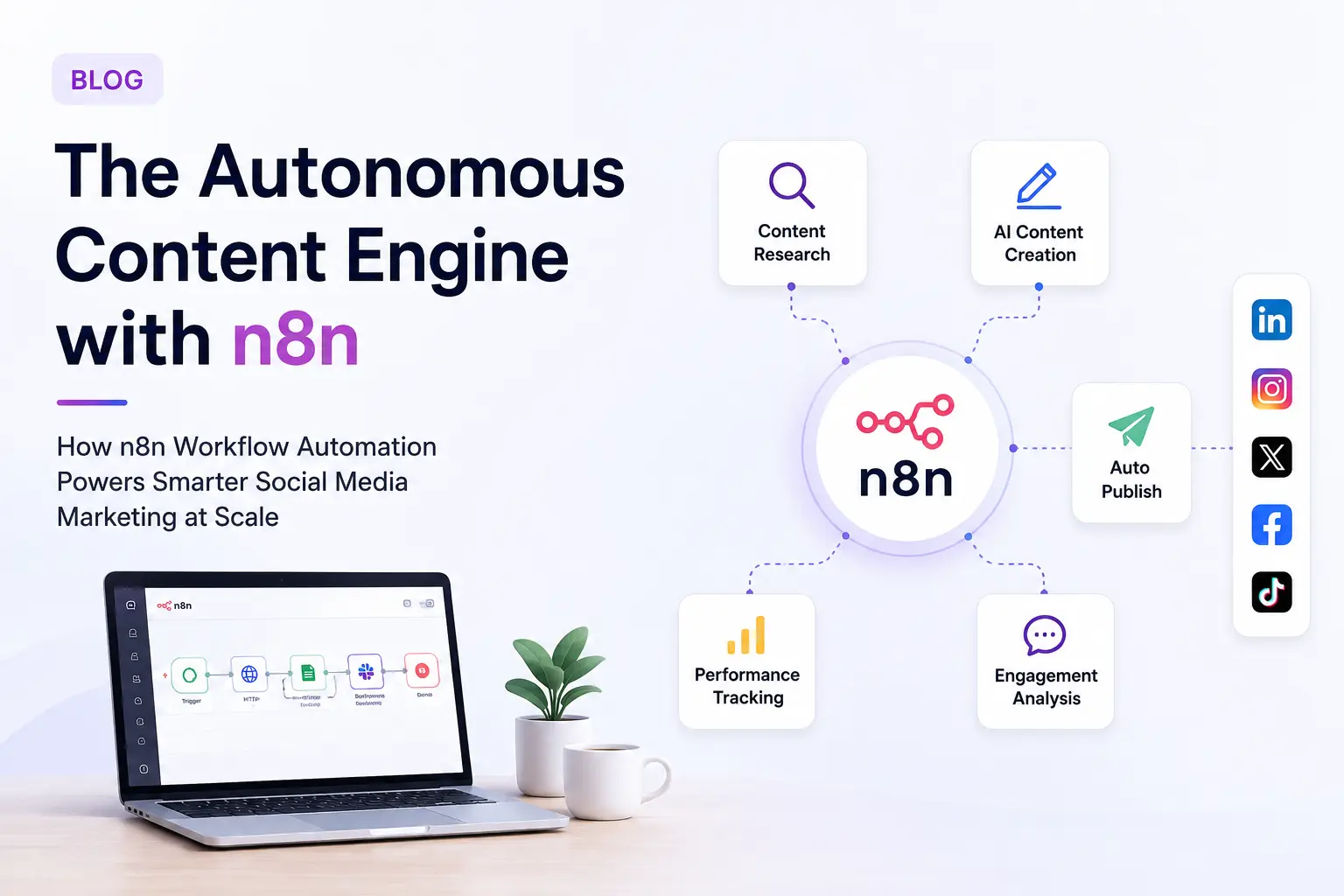
This is where n8n is changing the landscape of social media automation. n8n allows businesses to build what many marketers now call an Autonomous Content Engine. Instead of handling every content task manually, companies can create connected workflows that automate content research, AI content generation, publishing, reporting, analytics, and performance monitoring from one centralized system.
For businesses trying to scale content production without increasing workload, automation is becoming a major competitive advantage.
What Is an Autonomous Content Engine?
An Autonomous Content Engine is a connected automation system that manages repetitive content marketing operations through intelligent workflows.
Instead of manually performing every task, businesses can automate large parts of the social media process, including:
- Content research
- Caption generation
- AI content creation
- Graphic production
- Platform adaptation
- Social media publishing
- Engagement tracking
- Performance reporting
- Lead notifications
- Content repurposing
The primary goal is simple. Automation handles operational tasks while teams focus on creative strategy and business growth. Content demand has increased dramatically across every platform. Businesses now need daily content for:
- X
- Threads
- TikTok
- YouTube Shorts
Managing all these channels manually creates bottlenecks and delays. Automation removes those limitations and helps businesses maintain a consistent content presence without increasing operational pressure.
Why Businesses Are Choosing n8n
n8n has become one of the fastest-growing workflow automation platforms for agencies, startups, and scaling businesses. The biggest reason is flexibility. Unlike traditional scheduling tools, n8n allows businesses to build advanced workflows with custom logic, AI integrations, and automated decision-making systems.
Businesses can create workflows that:
- Convert LinkedIn posts into X threads automatically
- Turn blog articles into Instagram carousel content
- Send notifications when engagement increases
- Generate AI-powered captions
- Repurpose long-form content into short-form videos
- Trigger lead alerts for sales teams
- Automate approval systems
- Generate reports automatically
This creates a smarter and more scalable content operation.
Another major reason businesses prefer n8n is cost efficiency.
Many SaaS automation tools increase pricing based on usage limits, tasks, or team size. As businesses scale content production, operational costs also rise quickly.
n8n offers self-hosting capabilities, which helps businesses maintain control over:
- Data ownership
- Infrastructure
- Security
- Workflow customization
- Long-term operational expenses
For agencies managing multiple clients, this becomes highly valuable.
The Four Layers of a Smart Social Media Automation System
A strong automation system is not built around one workflow. It works through multiple connected layers that manage different parts of the content process. When combined together, these layers create a complete Autonomous Content Engine.
1. Content Input Layer
Every automation system starts with content input. The workflow needs reliable sources of information, trends, ideas, and audience insights. Businesses usually connect n8n with databases, spreadsheets, content libraries, trend monitoring tools, and external APIs.
Common input sources include:
- Airtable
- Google Sheets
- RSS feeds
- Trend monitoring tools
- Internal content libraries
- Customer feedback systems
- News APIs
- CRM platforms
Some businesses also use performance-based learning systems. In this setup, n8n scans older high-performing posts and identifies patterns based on audience engagement. The workflow can then recommend similar topics automatically. This creates a smarter content cycle and improves long-term content consistency.
2. AI Processing Layer
After content ideas enter the workflow, AI tools process the information and generate content assets automatically. This layer acts as the operational brain of the system.
AI-powered workflows can help businesses:
- Generate captions
- Write social media posts
- Create blog summaries
- Produce graphics
- Generate video scripts
- Analyze readability
- Maintain brand tone consistency
- Generate content variations
The purpose of automation is not to replace marketers. The goal is to reduce repetitive production work so teams can focus on strategic decision-making and creative execution. Modern AI systems also help businesses maintain consistency across every platform by following predefined tone structures, writing styles, and brand guidelines.
3. Platform Adaptation Layer
One of the biggest mistakes businesses make is posting identical content across every platform. Different social media platforms require different content styles, formats, and communication approaches.
For example:
- LinkedIn audiences prefer professional insights
- Instagram users engage more with visual storytelling
- X performs better with concise conversations
- TikTok prioritizes short-form entertainment content
An Autonomous Content Engine adapts content automatically for each platform.
This may include:
- Converting blogs into X threads
- Removing hashtags for LinkedIn
- Adding call-to-actions for Instagram
- Turning content into TikTok scripts
- Creating shorter mobile-friendly captions
- Repurposing long-form content into short-form formats
This improves engagement because the content feels native to the platform instead of duplicated.
4. Distribution and Feedback Layer
Once the content is ready, the workflow publishes it automatically across connected platforms. n8n supports integrations with social media tools, communication platforms, CRMs, analytics systems, and reporting tools.
After publishing, the workflow continues monitoring performance metrics such as:
- Likes
- Shares
- Comments
- Click-through rates
- Watch time
- Lead activity
- Engagement growth
If a post performs well, the workflow can trigger additional automation actions automatically.
For example:
- Notify the sales team
- Create follow-up posts
- Generate email campaigns
- Repurpose the topic into blog content
- Create additional social media variations
- Generate analytics reports
This creates a continuous feedback loop where the workflow learns from audience behavior over time.
Why Human Review Still Matters
Even advanced automation systems should not operate without human oversight.
AI-generated content still requires review for:
- Accuracy
- Context
- Brand tone
- Compliance
- Quality control
This is why many businesses implement Human-in-the-Loop approval systems. Before content goes live, n8n can send drafts to internal communication channels where managers or content teams can review the output before publishing.
Businesses can:
- Approve content
- Request revisions
- Pause publishing
- Regenerate outputs
- Add manual edits
Automation improves speed, but human judgment protects brand quality and audience trust. Businesses that combine automation with human oversight usually achieve stronger long-term results.
The Role of AI Workflow Design in Modern Marketing
Automation is no longer only about scheduling content. Businesses are now building complete AI-powered ecosystems that combine automation logic, content generation, audience targeting, analytics, and reporting into one connected workflow system.
AI workflow design helps businesses:
- Reduce repetitive tasks
- Improve workflow efficiency
- Scale content production
- Maintain brand consistency
- Improve publishing speed
- Increase operational efficiency
- Automate marketing processes
Businesses investing in AI workflow systems are gaining a significant advantage because they can execute campaigns faster while maintaining consistency across multiple channels.
How Social Media Automation Supports Business Growth
Modern businesses cannot rely only on manual publishing anymore. Content demand continues increasing across every digital platform. Brands are expected to maintain an active presence across multiple channels while publishing high-quality content consistently.
Social media automation helps businesses:
- Publish content consistently
- Repurpose content faster
- Improve workflow efficiency
- Reduce operational delays
- Monitor engagement automatically
- Maintain content consistency
- Improve team productivity
Businesses working with automation systems can scale marketing operations faster without increasing team workload. At the same time, workflow automation helps centralize operations into one connected system instead of managing multiple disconnected tools manually.
The Future of Content Marketing
Content marketing is moving toward connected systems instead of isolated manual tasks.
Businesses that continue relying only on manual workflows will struggle to maintain consistency as content demand increases. Automation is no longer only about saving time. It is about building scalable marketing operations that improve efficiency, consistency, and long-term growth.
The fastest-growing businesses today are using automation to:
- Produce content faster
- Respond to trends quickly
- Repurpose content efficiently
- Improve workflow scalability
- Reduce production delays
- Increase operational efficiency
- Scale campaigns without increasing workload
At the same time, human creativity still plays an important role. Strong storytelling, audience understanding, creative strategy, and brand positioning cannot be fully automated. The best marketing systems combine human creativity with machine efficiency.
Frequently Asked Questions
Do you need coding knowledge to use n8n?
n8n is considered a low-code platform, so businesses do not need advanced programming knowledge to start using it. Most workflows are built visually using drag-and-drop nodes. However, understanding APIs, automation logic, and basic JSON structures can help businesses create more advanced workflows and improve automation performance over time.
Is social media automation safe for business accounts?
Yes, social media automation is safe when businesses focus on quality content instead of spam-based automation. Platforms usually penalize low-quality activity, not automation itself. Businesses that create valuable content, maintain platform-specific formatting, and use human review processes can automate publishing safely while maintaining healthy engagement and account performance.
Can n8n automate short-form video content?
Yes, n8n can connect with AI video generation platforms and automation tools to create short-form video workflows. Businesses can automate parts of TikTok, Instagram Reels, and YouTube Shorts production using AI-generated scripts, captions, voiceovers, publishing workflows, and performance tracking systems integrated directly into the automation process.
Why are businesses investing in AI workflow automation?
Businesses are investing in AI workflow automation because content demand is increasing rapidly across every platform. Automation helps companies reduce repetitive work, improve publishing consistency, scale campaigns faster, and increase operational efficiency. It also allows marketing teams to focus more on strategy, audience engagement, and business growth instead of repetitive manual tasks.
What industries can benefit from n8n workflow automation?
Almost every industry can benefit from workflow automation. Digital marketing agencies, eCommerce brands, SaaS companies, healthcare businesses, education platforms, finance companies, and content creators are all using automation systems to improve productivity, reduce operational workload, automate reporting, and scale marketing operations more efficiently.
Final Thoughts
Social media marketing is becoming more demanding every year. Businesses are expected to produce more content across more platforms while maintaining quality, consistency, and engagement.
Manual workflows are no longer enough for brands that want to scale efficiently. n8n helps businesses build intelligent automation systems that handle content research, AI generation, publishing, analytics, reporting, and performance tracking from one centralized workflow. The biggest advantage is not only speed. It is scalability, operational efficiency, and smarter content management.
Automation gives marketing teams more time to focus on:
- Creative strategy
- Audience engagement
- Brand positioning
- Campaign planning
- Business growth
- Long-term marketing goals
The future of digital marketing belongs to businesses that build connected systems instead of relying only on manual effort.