Your Website Is Your Revenue Engine
In 2026, a website is no longer just a digital presence. It is the backbone of your business growth. It drives visibility, builds credibility, captures leads, and directly impacts conversions. Every click, scroll, and second of load time influences how users perceive your brand and whether they choose to trust you.
User expectations have evolved rapidly. Today’s audience expects fast-loading websites, mobile-first experiences, and intelligent personalization powered by AI. Search engines prioritize Core Web Vitals, real user engagement, and seamless navigation. If your website does not meet these expectations, it does not just lose traffic, it loses opportunities.
This brings us to a critical business decision. Should you build your website using WordPress or invest in custom development. This guide provides a clear, practical comparison to help you make a data-driven decision that supports long-term growth.
The Evolution of WordPress in 2026
WordPress has grown into one of the most powerful content management systems in the world. It has evolved far beyond blogging and now supports complex websites, eCommerce platforms, and scalable digital ecosystems.
Modern WordPress includes advancements such as Headless WordPress, block themes, Progressive Web Apps, and AI-driven personalization. These innovations allow businesses to combine flexibility with improved performance.
One of the biggest advantages of WordPress is speed to market. Businesses offering Website Development can quickly deploy websites using pre-built themes and plugins. This makes it ideal for startups and businesses that want to establish an online presence without delays.
Key benefits of WordPress include
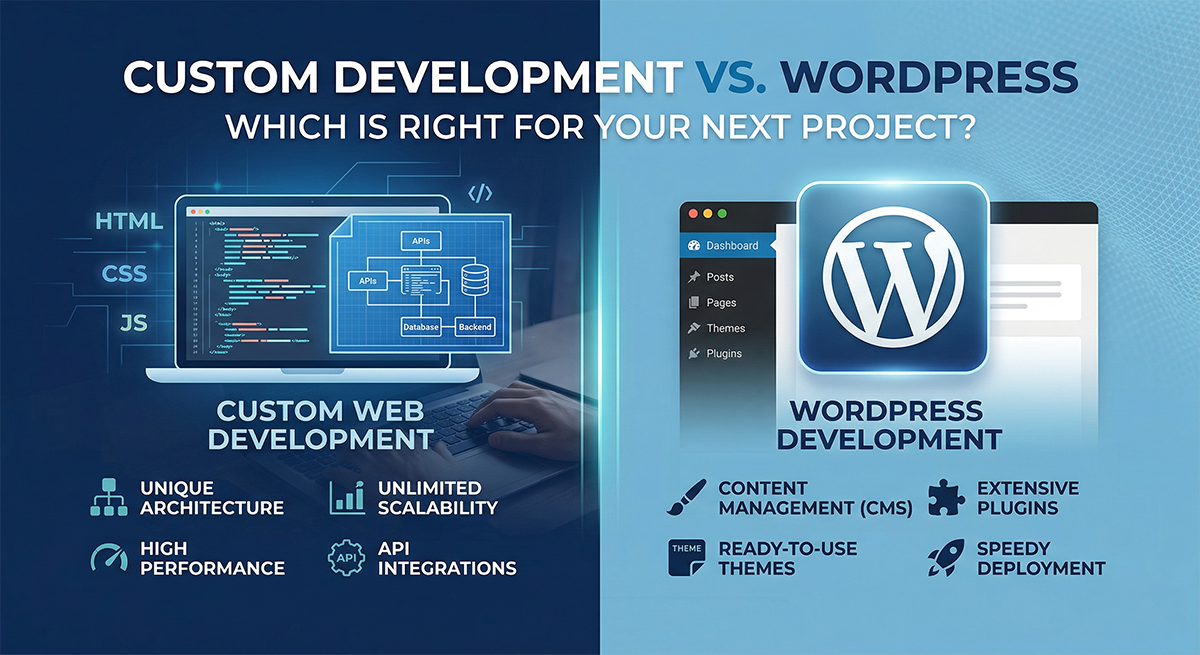
- Quick website launch with minimal development time
- Easy content management for blogs and landing pages
- Large plugin ecosystem for extended functionality
- Cost-effective solution for small and medium businesses
WordPress also supports efficient content management. Teams working on Digital Marketing campaigns can easily publish blogs, landing pages, and updates without technical complexity. This ensures consistent content delivery, which is essential for SEO and audience engagement.
However, WordPress comes with limitations that businesses must consider. As websites scale, plugin usage increases, which can lead to slower performance and compatibility issues. Security is another concern, as frequent updates and vulnerabilities require ongoing monitoring.
Common limitations of WordPress include
- Plugin dependency affecting speed and stability
- Regular maintenance and security updates required
- Performance challenges on shared hosting
- Difficulty in achieving perfect Core Web Vitals without optimization
To maintain performance and stability, many businesses rely on WordPress Management for regular updates, security patches, and optimization. Without this, even a well-built WordPress site can struggle to meet modern performance standards.
The Power of Custom Web Development
Custom web development offers complete control over your website. It allows you to build a platform tailored specifically to your business requirements without relying on predefined structures.
In 2026, custom development uses modern frameworks such as React and Next.js, along with decoupled architecture and cloud-based hosting. This approach ensures that your website is lightweight, fast, and highly scalable.
One of the biggest advantages of custom development is performance. Clean and optimized code eliminates unnecessary elements, resulting in faster load times and better user experience. This directly improves search rankings and conversion rates.
Key advantages of custom development include
- High performance with lightweight and clean code
- Full control over design and functionality
- Seamless integration with APIs and third-party tools
- Better scalability for growing businesses
Custom development also enables advanced integrations. Businesses can connect CRMs, automation tools, and third-party APIs seamlessly. For companies offering Android App Development, custom development ensures that web and mobile platforms work together efficiently.
Scalability is another key benefit. With the support of Cloud Management, custom websites can handle high traffic volumes without performance issues. This makes them ideal for growing businesses and enterprise-level operations.
The main limitation of custom development is the higher initial investment and longer development timeline. However, for businesses focused on long-term growth, the benefits often outweigh the cost.
Key considerations before choosing custom development
- Higher upfront investment compared to WordPress
- Longer development and testing timeline
- Requires experienced developers for maintenance
- Best suited for long-term scalability goals
SEO and Performance Head to Head
SEO is one of the most important factors in choosing a platform. Both WordPress and custom development offer advantages, but they differ in execution.
WordPress provides strong SEO capabilities through plugins and built-in tools. It allows businesses to optimize content, manage metadata, and implement basic technical SEO practices. This makes it a good choice for content-driven strategies.
WordPress SEO strengths include
- Easy on-page optimization with plugins
- Simple content publishing for keyword targeting
- Built-in blogging capabilities
- Large community support for SEO tools
However, WordPress websites often include extra code from themes and plugins. This can slow down performance and affect Core Web Vitals. Without proper optimization, it becomes difficult to meet search engine standards.
Custom development offers complete control over SEO and performance. Developers can optimize every aspect of the website, including code structure, server response time, and user experience. This results in faster loading speeds and better rankings.
Custom development SEO advantages include
- Clean and optimized code structure
- Faster server response and page load speed
- Advanced schema implementation
- Improved crawlability and indexing
Decision Matrix: Choosing the Right Path
Choosing between WordPress and custom development depends on your business goals and growth plans.
Choose WordPress if
- You need a quick and cost-effective website launch
- Your strategy is focused on content marketing
- You want easy website management without technical complexity
- Your business is in the early or mid-growth stage
Choose custom development if
- You are building a complex platform or SaaS product
- You need advanced integrations or automation systems
- Your website handles high traffic volumes
- You want complete control over performance and scalability
How FlipGrowth Bridges the Gap
The platform you choose is important, but execution is what drives results.
At FlipGrowth, the focus is on building websites that deliver measurable outcomes. The team combines technical expertise with marketing strategy to create high-performing digital assets.
Key strengths of FlipGrowth include
- Deep expertise in both WordPress and custom development
- Performance-focused website architecture
- SEO-driven design and development approach
- Scalable solutions aligned with business growth
With over five years of experience, FlipGrowth understands the relationship between website performance, SEO, and user behavior. Whether it is a WordPress website or a custom-built platform, every project is designed to maximize visibility, engagement, and conversions.
Conclusion: Build for the Future
There is no single solution that fits every business. WordPress offers flexibility and speed, making it a great starting point. Custom development provides performance and scalability, making it ideal for long-term growth.
The key is to choose a platform that aligns with your business goals and supports your future expansion.
Successful businesses focus on
- Building fast and user-friendly websites
- Optimizing for search engines and conversions
- Scaling their digital infrastructure over time
- Investing in long-term performance and growth
Call to Action: Start Building with Strategy
Do not rely on assumptions when making a critical decision about your website.
Connect with FlipGrowth for a free technical consultation and digital audit. Understand your current performance, identify opportunities, and build a roadmap for scalable growth.
Your website should not just exist. It should perform, convert, and grow with your business.
FAQs
Which platform is better for long-term growth?
Custom development is better for long-term growth because it provides complete control over performance, scalability, and advanced functionality. It allows businesses to build tailored solutions that handle high traffic, complex integrations, and evolving requirements. While WordPress is flexible, custom platforms are designed specifically for expansion, making them ideal for companies planning sustained digital growth and higher user demand.
Is WordPress good for SEO in 2026?
Yes, WordPress is still a strong platform for SEO in 2026 due to its flexibility and wide range of optimization tools. It supports content creation, metadata management, and plugin-based SEO improvements. However, achieving top performance requires proper hosting, theme optimization, and speed enhancements. Without these, WordPress websites may struggle to meet Core Web Vitals and advanced search engine ranking factors.
Can I start with WordPress and switch later?
Yes, starting with WordPress is a common strategy for businesses that want a quick and cost-effective launch. As the business grows and requires better performance or advanced features, migrating to custom development becomes a logical step. Planning this transition early helps maintain SEO rankings, ensures smooth data migration, and minimizes disruptions to user experience and overall website functionality.
How do I decide what is right for my business?
The right choice depends on your business goals, budget, and technical requirements. WordPress is suitable for fast launches and content-driven strategies, while custom development is ideal for scalability and advanced functionality. Evaluating your long-term growth plans and consulting with experts can help you choose a platform that aligns with your vision and delivers sustainable digital success.