Businesses today are under constant pressure to work faster while reducing operational costs. As companies grow, daily operations become more complex because customer data moves across websites, CRMs, spreadsheets, email marketing platforms, and internal communication systems. Many teams still spend hours manually updating records, managing leads, and transferring information between tools. Over time, these repetitive tasks slow productivity, create operational bottlenecks, and reduce overall efficiency.
This is why workflow automation has become a major priority for modern businesses. Companies are now searching for flexible systems that can automate repetitive work without requiring expensive software development teams. Two technologies driving this shift are Vibe Coding and n8n. Together, they help businesses automate operations, generate custom workflow logic, and improve scalability without relying completely on traditional coding methods.
The biggest change is accessibility. Businesses no longer need advanced engineering teams for every small operational update. Instead, teams can describe what they want in simple language while AI tools generate the code needed to power those workflows. This reduces technical barriers and allows businesses to move faster in a competitive digital environment.
What Is Vibe Coding?
Vibe coding is an AI-assisted development approach where users describe software functionality using natural language instead of manually writing code line by line. The AI interprets the request and generates usable code snippets based on the instructions provided. This allows businesses to focus more on workflow logic and operational goals instead of spending time on programming syntax and technical debugging.
For example, a marketing team might want to automatically clean customer phone numbers before storing them inside a CRM. Instead of hiring a developer to write a custom script manually, they can simply ask an AI tool to create a function that removes spaces, country code formatting, or unwanted characters. The AI then generates the code within seconds, allowing the business to deploy the workflow much faster.
This shift is important because businesses increasingly depend on automation to stay competitive. AI-assisted coding speeds up testing, deployment, and operational experimentation. Companies can launch new workflows, optimize lead systems, and build internal automation tools without waiting through long development cycles. This makes automation more practical for startups, agencies, marketers, and growing businesses with limited technical resources.
Why Businesses Are Investing in Workflow Automation
As businesses scale, operational inefficiencies become harder to manage manually. Teams often deal with repetitive work such as copying leads into spreadsheets, updating CRMs manually, organizing customer information, or sending repetitive follow-up messages. These tasks consume valuable time that could otherwise be spent on strategy, sales, customer relationships, and growth activities.
Without automation, businesses commonly face problems like:
- delayed lead responses
- inconsistent customer data
- repetitive manual data entry
- disconnected systems
- reporting delays
- workflow inefficiencies
Traditional automation platforms solve some of these issues, but many tools become expensive as workflow complexity grows. Businesses also discover that some no-code platforms have limited customization options, making it difficult to adapt workflows to unique operational requirements. On the other hand, custom software development offers flexibility but often requires large budgets, technical hiring, maintenance costs, and ongoing development management.
This is exactly why businesses are moving toward flexible automation systems like n8n. It provides visual workflow management while still allowing deeper customization when businesses need advanced operational logic.
What Makes n8n Different From Traditional Automation Tools?
n8n is a workflow automation platform designed to connect apps, databases, APIs, websites, CRMs, and communication systems into one centralized workflow environment. Businesses use it to automate the movement of data between platforms without requiring constant human involvement.
Unlike many basic automation tools, n8n combines visual workflow building with advanced customization capabilities. Users can create drag-and-drop workflows while also inserting custom JavaScript logic whenever workflows require more advanced processing.
Businesses commonly use n8n for:
- lead management automation
- CRM synchronization
- email automation
- customer onboarding
- AI workflow integration
- eCommerce operations
- reporting systems
- support ticket automation
The platform supports hundreds of integrations, allowing businesses to connect tools like WordPress, Slack, Google Sheets, databases, CRMs, and AI systems into a single operational workflow. This flexibility makes it highly attractive for agencies, startups, and digital businesses that require scalable automation infrastructure.
How Vibe Coding and n8n Work Together
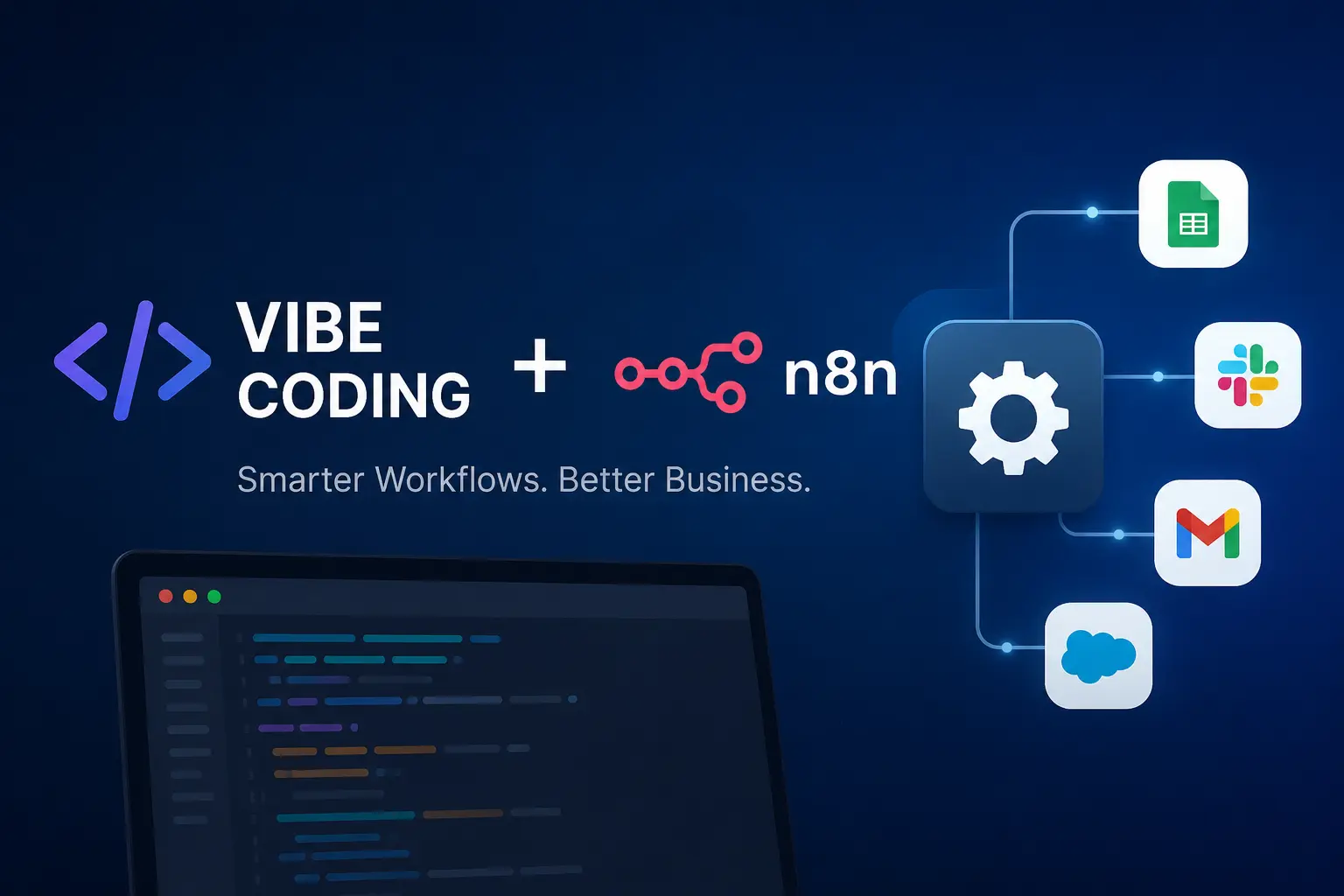
The combination of vibe coding and n8n creates a powerful automation environment because both systems solve different operational challenges. n8n manages the workflow structure while vibe coding helps generate custom logic when workflows require advanced data processing or conditional behavior.
A business might begin by creating a workflow where leads from a website form automatically enter a CRM. However, before storing the lead data, the workflow may need to validate email addresses, remove duplicate records, format phone numbers, categorize lead sources, or assign lead scores based on customer actions.
Traditionally, businesses would require a developer to write custom scripts for these operations. With vibe coding, teams can describe the exact logic they need in plain English, and AI tools generate the required JavaScript automatically. That generated code can then be inserted directly into an n8n Code Node, extending the workflow without requiring full-scale software development.
This process dramatically reduces implementation time while improving workflow flexibility. Businesses can build and test automation systems within hours instead of waiting days or weeks for custom development. Your uploaded content also explains this workflow structure effectively by showing how businesses visually map workflows and insert AI-generated scripts into automation pipelines.
Major Benefits of Using Vibe Coding With n8n
One of the biggest advantages of combining vibe coding with n8n is faster workflow deployment. Businesses can launch automation systems rapidly without depending on long development cycles. Marketing teams can automate campaigns faster, sales teams can improve lead routing systems, and customer support operations can reduce repetitive manual tasks.
Another major benefit is lower development costs. Hiring developers for every operational workflow becomes expensive over time, especially for small and medium-sized businesses. AI-assisted code generation reduces repetitive programming work while allowing businesses to create customized systems at a much lower cost.
The combination also improves scalability. Businesses can expand workflows as operations grow without rebuilding their infrastructure entirely. New systems, APIs, and operational processes can be integrated into existing workflows quickly, helping businesses adapt faster to market changes.
Operational efficiency also improves significantly because employees spend less time on repetitive administrative tasks. Teams can focus more on revenue-generating activities such as customer communication, strategy development, marketing execution, and sales optimization. This creates smoother internal operations while improving overall productivity across departments.
Why Human Oversight Still Matters
Although automation technology has improved significantly, businesses should avoid creating completely hands-off systems without human supervision. Automation is highly effective for repetitive operational work, but strategic thinking, quality control, and decision-making still depend on human expertise.
This is especially important for SEO and content operations. Google increasingly prioritizes experience, expertise, trust, and content quality. Businesses that publish large amounts of unreviewed AI-generated content often struggle with weak user engagement and poor long-term search performance.
The best approach is hybrid execution. Businesses should use automation for backend processes such as formatting, organization, lead routing, and repetitive workflow tasks while keeping humans responsible for strategic planning, content quality, customer communication, and operational decisions.
Your uploaded draft strongly emphasizes this balance between automation and human oversight, which aligns well with modern SEO and operational best practices.
Real Business Use Cases for Vibe Coding and n8n
Businesses across multiple industries are already using vibe coding and n8n to improve operations and reduce manual work. Marketing agencies automate lead management systems that capture leads from websites, qualify them automatically, and send them directly into sales pipelines. eCommerce businesses automate order updates, shipping notifications, and customer communication workflows to improve operational speed.
Customer support teams use automation to organize support tickets, trigger responses, and route inquiries to the correct departments automatically. Content teams use AI-powered workflows to move articles between writing systems, editing platforms, and publishing tools without constant manual management.
Businesses also use workflow automation for reporting systems. Instead of manually collecting data from multiple platforms, automated workflows can pull information from databases, CRMs, and analytics tools into centralized dashboards automatically. This reduces reporting delays while improving operational visibility.
Challenges Businesses Should Understand Before Automating
Although automation provides significant benefits, poor implementation can create operational problems. Businesses still need a clear understanding of workflow architecture, API connections, data structure, and operational goals before building automation systems.
Common automation challenges include:
- incorrect workflow logic
- poor data handling
- broken API integrations
- security risks
- inefficient workflow structure
AI tools can generate code quickly, but businesses still need proper testing and operational planning. Automation should simplify operations rather than create additional complexity. Companies that approach automation strategically usually achieve better long-term scalability and operational stability.
The Future of AI Workflow Automation
The future of business automation will likely combine AI-assisted coding, workflow automation platforms, API-driven systems, and human-led operational strategy. Businesses are increasingly shifting toward automated infrastructure because it allows them to scale operations without increasing manual workload at the same pace.
Small businesses now have access to tools that were previously available only to large enterprise organizations with dedicated engineering teams. This creates a major competitive advantage for companies willing to adopt automation early and build efficient operational systems.
However, the businesses that succeed long term will not simply automate everything blindly. The strongest companies will combine automation efficiency with strong strategic oversight, high-quality customer experiences, and intelligent operational planning. Automation can improve speed and scalability, but human expertise remains the foundation that drives sustainable business growth.
Frequently Asked Questions
What is vibe coding?
Vibe coding is an AI-assisted coding method where users explain software functionality using plain English prompts. The AI then generates the required code automatically, helping businesses build workflows and automation systems faster without relying entirely on traditional programming methods.
Does n8n require coding knowledge?
No. Most workflows inside n8n can be built using drag-and-drop automation. However, advanced customization may require JavaScript code, and AI tools can help generate those scripts quickly using natural language instructions.
Can small businesses use n8n effectively?
Yes. Small businesses commonly use n8n for lead management, CRM synchronization, customer onboarding, email automation, reporting systems, and operational workflows because it offers flexibility without requiring expensive enterprise infrastructure.
Is AI-generated code reliable for business workflows?
AI-generated code can work very effectively for operational automation, but businesses should still review, test, and validate scripts before deploying them into production systems to ensure security, stability, and workflow accuracy.
Will workflow automation negatively affect SEO?
No. Workflow automation itself does not harm SEO. Search rankings are affected by poor-quality content, weak user experience, and lack of expertise, not by automation systems used behind the scenes.